Behind the Covers: A Conversation About Early Literacy, Digital Learning, and the Modern Library
What makes screen time meaningful for young learners, and how can libraries help children build both traditional literacy and real digital skills?
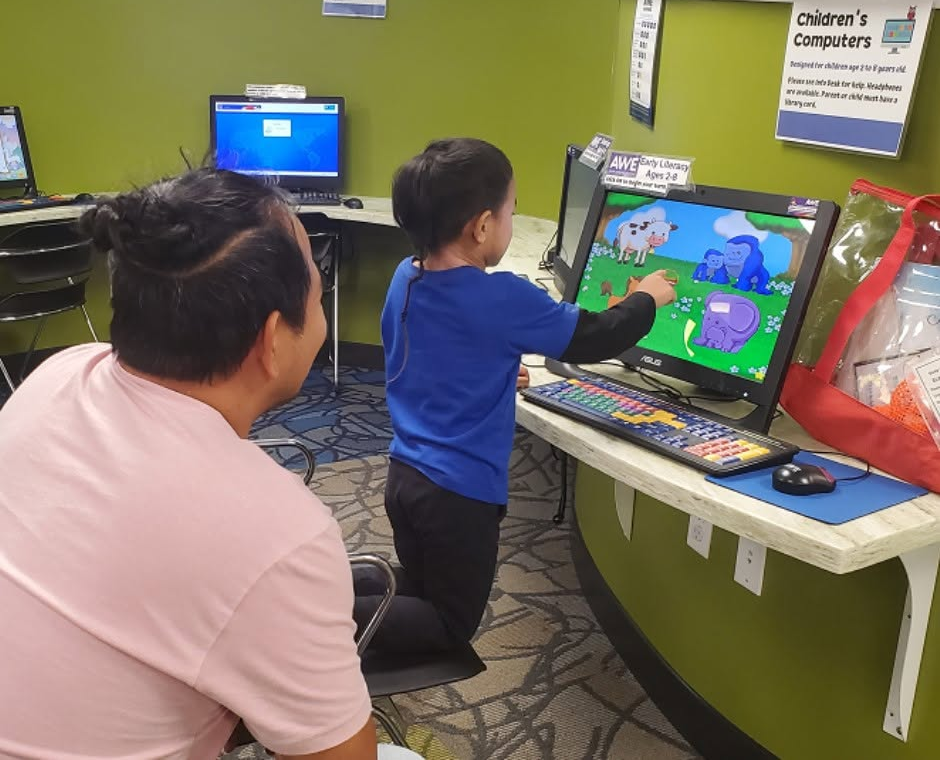
AWE Learning President Owen Brittan recently joined Dakota County Library’s Behind the Covers podcast to discuss the role of intentional educational technology in today’s libraries. During the conversation, Owen and the hosts talked about how AWE Learning workstations provide children with a safe, structured environment for active learning. AWE Workstations do not have open internet access, advertisements, logins, or distracting content.
The episode explores the difference between passive screen time and purposeful digital learning, including how touchscreen, mouse, and keyboard interaction can help children develop literacy, problem-solving, fine motor, navigation, and early computer skills. Owen also discusses the importance of self-paced, predictable learning experiences for neurodivergent and multilingual learners and the evolving role of libraries as trusted community spaces for both traditional and digital literacy, as well as future-readiness.
Listeners will also hear how feedback from librarians, educators, families, and library users continues to shape AWE Learning’s products and approach after more than 30 years of supporting libraries and young learners.
Listen to the Full Conversation
Hear the complete interview with Owen Brittan on Episode 27 of Dakota County Library’s Behind the Covers podcast.
☀️How to Increase Engagement with Your AWE Workstation This Summer
Summer is one of the busiest times of year for public libraries. With families visiting more often, summer reading programs in full swing, and children looking for ways to stay engaged, it is the perfect opportunity to get even more value from your AWE Learning workstation. It also plays an important role in helping combat summer learning loss by keeping children actively engaged in reading, problem-solving, and skill-building while school is out.
Having the workstation available is only part of the equation. The real impact comes from how visible and accessible it feels to families walking through your space. When children notice it, understand it, and return to it, that is when it becomes a meaningful part of their library experience. Simple, intentional promotion can make the difference between a workstation that is occasionally used and one that becomes a consistent, go-to destination for learning and exploration.
📈 Turning Awareness into Engagement
AWE Learning workstations are designed to support structured, skill-building screen time in a safe and distraction-free environment. They help children build foundational skills across reading, math, science, and more, while encouraging independent exploration. By incorporating touchscreen, mouse, and keyboard interaction, AWE also helps children develop essential digital literacy skills such as hand-eye coordination, fine motor control, navigation, and early typing confidence, which are skills that support school readiness and real-world computer use.
During the summer months, this becomes even more important. Libraries not only provide access to books but also support continued learning outside the classroom. When families are aware of what the workstation offers, they are far more likely to use it consistently.
Small changes can make a big difference. Placing simple signage near children’s areas helps draw attention. Mentioning the workstation during everyday interactions helps families understand its purpose. Featuring it in a social post or tying it into a program can turn curiosity into regular use.
🧰 A Simple Way to Get Started
To make this easier, AWE Learning has created a Promotional Kitthat gives libraries ready-to-use materials designed to increase awareness and encourage engagement. That gives libraries ready-to-use materials designed to increase awareness and encourage engagement.
Instead of having to create everything from scratch, the kit provides tools you can immediately print, post, or share. It includes in-library signage that helps children and caregivers quickly understand what the workstation offers, along with social media graphics that highlight the fun and educational experience it provides.
There are also resources designed specifically for parents and caregivers. These materials explain how children learn through play and offer simple ways to support that learning during a visit. Take-home items, such as bookmarks, help extend that awareness beyond the library and encourage families to come back and use the workstation again.
For libraries looking to go a step further, the kit includes easy programming ideas that can help turn the workstation into a repeat destination. Whether it is a themed discovery day, a computer coding-focused activity, or a language-based event, these ideas are designed to fit naturally into existing summer programming.
🌟 Making the Most of Summer Traffic
Summer brings increased energy and opportunity into the library. With just a bit of added visibility and a few intentional touchpoints, your AWE Learning workstation can become a consistent part of how families engage with your space.
The goal is not to add more work for staff. It is to make promotion simple, consistent, and effective so that more children can discover and benefit from what is already available.
If you would like help identifying which materials will work best in your space, your AWE Learning representative is always available to provide guidance, share ideas, and support your summer engagement goals.
Enjoy our blog? Subscribe here to receive our quarterly newsletter featuring a new blog directly in your inbox!
Learn more about AWE Learning with your local representative to explore your options.
A Conversation with Our New President: Welcoming Owen Brittan, Ph.D. to AWE Learning
As we celebrate World Read Aloud Day and National Library Lover’s Month, we’re excited to introduce AWE Learning’s new President, Owen Brittan, Ph.D. We sat down with Owen to discuss libraries, learning, and what’s ahead for AWE Learning.
Q: Owen, welcome to AWE Learning! What drew you to this role?
Owen: Thank you, I’m really excited to be here. What drew me to AWE Learning is how deeply rooted the company is in libraries and communities. Libraries have always been a meaningful part of my life. My parents used to take us to the local library all the time, and I would go straight for the computers to play Oregon Trail or the history section to look at books about WWII. I’ve also interned at the Dwight D. Eisenhower Presidential Library and the Newcastle University Robinson Library. AWE has spent decades supporting that mission, especially with children and families.
“Libraries are one of the few places left where everyone is welcome and learning is free.”
Owen Brittan, Ph.D.
Q: February is National Library Lover’s Month. What do libraries mean to you?
Owen: Libraries are one of our most important community anchors, as one of the few free public spaces left. They support learning far beyond books, from early literacy and after-school programs to workforce development to family services.
“I love that AWE Learning fits naturally into library programming by providing safe, engaging learning opportunities for kids while families use other resources.”
Owen Brittan, Ph.D.
Q: World Read Aloud Day has just passed. How does that connect to AWE Learning’s work?
Owen: Reading aloud is one of the simplest and most powerful ways to support early learning. It builds vocabulary, comprehension, confidence, and connection. AWE’s content is designed to complement those moments by helping children explore letters, words, stories, and ideas independently, while reinforcing the literacy experiences they have with caregivers, educators, and librarians.
Q: How do you think about technology and children’s learning?
Owen: Screen time is part of modern childhood, but not all screen time is created equal. When used correctly, it can reinforce literacy, problem-solving, and curiosity. AWE Learning strikes that balance by offering structured, age-appropriate experiences that are safe and engaging, while still encouraging exploration and creativity. That distinction really matters to families and educators. Growing up, I had an IEP due to my struggles learning to read in early elementary school. I was lucky enough to have constant encouragement and access to some resources on our home computer. AWE workstations provide similar support to what I had at home, but in a public space available to everyone.
Q: What role do families play in AWE Learning’s mission?
Owen: Families are central. Libraries are often places where parents and caregivers juggle many needs, whether that’s job searching, classes, or using community services. Because our workstations are offline, AWE provides a safe, trusted space where children can learn independently without staff or parental supervision, which gives families flexibility. They can take advantage of the community programming libraries have to offer while knowing their kids are engaged in meaningful learning.
Q: What’s your vision for AWE Learning moving forward?
Owen: My focus is on stewardship and stability. Libraries rely on solutions that are stable, safe, and easy to manage. AWE Learning is in nearly 50% of public libraries across the country. We have built that trust by supporting our partners for decades. My goal is to strengthen that foundation by continuing to support our partners in a meaningful way as they plan confidently for the future.
We’re thrilled to welcome Owen to AWE Learning and look forward to continuing our work alongside libraries, educators, and families everywhere.
Enjoy our blog? Subscribe here to receive our quarterly newsletter featuring a new blog directly in your inbox!
Learn more about AWE Learning with your local representative to explore your options.
From User Feedback to Global Favorites: How IDZ Crafts Learning Through Play
At IDZ Digital, creating meaningful, playful, and educational experiences for kids begins with one thing: listening. With over 400 million downloads across their apps, the company’s success is no accident. Every animation, interactive game, and feature is shaped by the voices of parents, children, and educators who use them. In this interview, the IDZ team shares how feedback drives their innovation, the inspiration behind their popular titles, and what exciting new projects are on the horizon for 2025
Q: Much of IDZ’s content is inspired by customer feedback. How essential is it for your team to receive feedback on your content, and how does it help shape or improve your products?
IDZ: Feedback from parents and kids shows us what excites children, supports their learning, and where we can improve—keeping our apps fresh, fun, and effective. We receive feedback from multiple sources like app reviews, support queries, user testing sessions, conversations with users, and blogger reviews. This helps us understand what we’re doing well, where we can grow, and where the opportunity lies to improve. This continuous feedback loop plays a crucial role in driving ongoing improvements. It ensures that our apps evolve in the right direction to deliver the best possible learning experience for our audience.
Q: Geometry Shapes—Pre-K is one of IDZ’s most popular titles. How did feedback on this title help inspire other content?
IDZ: When exploring early-learning content, we realized that math could be exciting and engaging for kids through interactive games. That led to the creation of Geometry Shapes—Pre-K (Math Preschool).
Feedback and reviews on this title helped us refine it and inspired us with new creative ideas. While this title remains a favorite among users, we’ve developed even more popular apps like KidloLand, Coloring Club, Baby World, Dino Preschool, and many more. Many of these award-winning apps were born from listening to our users and understanding their needs—and today, they’re enjoyed by millions of children around the world.
Q: What new titles or projects is IDZ working on that users can look forward to in 2025?
IDZ: We’re excited about what’s ahead! In 2025, we’re expanding our offerings across the Baby, Preschool, Coloring, and Cooking genres.
Some of our recent launches include Princess Preschool, which blends fun themes with early learning. Coming soon are Montessori Games for Kids in 3D, Monster Truck 3D, and Supermarket Game 3D. We’ve also released Pizza Preschool Learning Games and have more upcoming titles focused on creativity, cooking, and coloring. We’re committed to delivering fresh, meaningful experiences that kids love.
Q: Play is at the heart of IDZ’s mission. How important is play in early childhood development?
IDZ: Play is one of the most powerful tools for early learning. It sparks curiosity and makes learning joyful and natural. We believe that when learning feels like play, children are more engaged and retain concepts better.
We invest time in understanding how children interact with our apps—watching real-life videos of kids using them—so that we can ensure our games and activities are both fun and developmentally appropriate. For us, play isn’t just entertainment; it’s the foundation of early skill-building.
Q: What is the origin story behind IDZ Digital? How and why was the company founded?
IDZ: IDZ began back in 2004 as a small online birthday greeting card website. Over time, we explored various online products before stepping into the kids’ early learning space. Our first real step came with a simple nursery rhymes app that featured just five rhymes. That app became the foundation of KidloLand Nursery Rhymes, our first official app, launched in 2012. Its success convinced us to focus entirely on educational apps. Since then, we’ve created a wide range of award-winning, engaging learning apps that have brought joy and education to millions of children globally.
With their focus on fun, feedback, and foundational learning, IDZ continues to shape the future of early childhood education through technology—one joyful app at a time.
Enjoy our blog? Subscribe here to receive our quarterly newsletter featuring a new blog directly in your inbox!
Learn more about AWE Learning with your local representative to explore your options.
Premier Content Partner Spotlight: Help Me 2 Learn An Interview with Owner Dan Sheffield
At AWE Learning, we’re passionate about providing fun, educational digital experiences for young learners, and that means partnering with the best in the industry. One of our standout content partners is Help Me 2 Learn!
Help Me 2 Learn has a long-standing commitment to making learning enjoyable and effective for children. Founded with the goal of combining education with technology in a meaningful way, they’ve developed award-winning programs that teach essential reading, phonics, math, and English language skills. Their interactive, game-based learning approach is built to engage children and reinforce key concepts in a fun, memorable way.
Through our partnership, Help Me 2 Learn’s dynamic content is seamlessly integrated into AWE Learning’s digital platform, making it available to young learners in libraries, classrooms, and other educational settings across the country. This collaboration ensures kids have access to research-based, developmentally appropriate tools that support foundational skill development and lifelong learning.
Together, AWE Learning and Help Me 2 Learn are helping educators inspire confidence, creativity, and curiosity in every child.
Q: What inspired the creation of Help Me 2 Learn, and how has your mission evolved since its inception?
Help Me 2 Learn: The inspiration behind Help Me 2 Learn stemmed from the simple joy of music. I discovered the Twin Sisters songs and was struck by how effectively they captured children’s attention and made learning fun. That sparked an idea—what if we built an entire educational experience around this kind of engaging, playful learning?
So we expanded on that foundation. We added lyrics, interactive content, games, and activities—all designed to reinforce early learning in a way that feels more like play than work. Our ‘Learn the Words’ vocabulary builder and the ‘Super Star Motivational and Data Tracking System’ became core to the experience, helping kids track progress and stay motivated.
Over time, we noticed that as students grew older, they began to outgrow the sing-along format. That led us to evolve. We introduced our Super Star Kids characters, who guide students through lessons with animated presentations. These enhancements ensure our platform continues to meet learners where they are—engaged, curious, and ready to succeed.
Q: With a focus on phonics, early learning, math, and language arts, how do you ensure the content remains engaging and effective for elementary students?
Help Me 2 Learn: While the core principles of early education haven’t changed much, the ways we teach—and how students engage—definitely have. That’s where Super Star by Help Me 2 Learn stands out. Our lessons are designed to be flexible and versatile. Teachers can use them for whole-class presentations, game-based competitions, or independent learning time.
What really makes our content stick is its structure. Every lesson includes a mix of multimedia: a song or animated explanation to introduce the concept, a ‘Learn the Words’ activity for vocabulary and phonics practice, and interactive games to reinforce learning. The variety keeps students engaged, and the repetition builds mastery.
We’re not here to replace teachers—we’re here to support them with tools that make learning more dynamic, inclusive, and fun.
Q: Can you elaborate on how Help Me 2 Learn personalizes learning experiences to cater to individual student needs?
Help Me 2 Learn: Personalization is built into the DNA of Super Star. Each student logs in with their own account, and from that moment, their learning journey is tracked and celebrated through our Super Star Motivational and Data Tracking System.
As students complete activities, songs, and games, they earn silver or gold stars based on their performance. If they make a few mistakes, they earn a silver star, but they’re always encouraged to try again for gold. This simple system not only provides immediate feedback but also creates a sense of achievement and motivation.
We’ve also designed flexibility into the system. Teachers can adjust difficulty levels or allow more leniency for students who need it. Some of our games even include alternative quizzes for those who might find certain activities challenging. It’s all about giving each child a path to succeed—at their own pace, in their own way.
Q: How does the platform support multilingual education, and what languages are currently available?
Help Me 2 Learn: While our platform is currently available only in English, its design is incredibly supportive of multilingual learners. A standout feature is our “Learn the Words” activity, which breaks down words visually and phonetically. Students see the word, hear it pronounced, view an image of it, and explore its phonemic structure using Elkonin boxes—those familiar letter blocks that help learners connect sounds with spelling.
This interactive multisensory approach helps English language learners build vocabulary and phonics skills with minimal reliance on translation. In our higher-level courses, we expand these tools to explore syllables and full sentences, further supporting language development.
In fact, this methodology has made our program popular internationally, especially in China. With some localized adaptations, our platform has found enthusiastic audiences abroad—proof that effective teaching tools can transcend language barriers.
Q: In what ways does Help Me 2 Learn accommodate students with special educational needs to ensure inclusivity?
Help Me 2 Learn: We’re incredibly proud of the positive impact our courses have had on students with special educational needs. Our system is designed to be accessible, engaging, and—perhaps most importantly—self-paced. Students can explore lessons at their own speed, without the pressure of keeping up with peers or rushing to finish.
One of the most rewarding moments was when a parent of a special needs student reached out after a technical issue disrupted their child’s learning. The urgency in that call showed how meaningful the program had become to that student. Once we addressed the problem, their joy was immediate—it was a moment that reminded us of why we do what we do.
In addition to the motivational gold and silver stars, we provide alternative options—like simplified quizzes—when games may be too challenging. This flexibility helps every learner find a way to succeed. As one longtime fan (who began using Super Star as a child with special needs and is now an adult) recently shared, “Super Star kids are fun, funny, and entertaining for kids. I love Super Star Games.” That’s the kind of feedback that stays with you.
Q: Could you share insights into how educators can monitor student progress and utilize the provided pedagogical recommendations?
Help Me 2 Learn: We’ve designed Super Star with educators in mind from the very beginning. As the platform evolved from CD-ROMs to networked school environments, we added robust teacher tools that make it easy to track progress and adapt instruction.
Teachers can access both class-wide and individual student reports, including pre- and post-tests, and adjust course settings for differentiated instruction. There are controls to manage game repetition (so students don’t just replay their favorites), assign specific lessons, and adjust difficulty levels as needed.
To help teachers make the most of these features, we provide an in-depth Teacher & Admin Resources course, complete with video tutorials and written guides. Our goal is to empower educators with both insight and flexibility—so they can tailor learning to each student’s needs while maximizing classroom impact.
Q: What role does the Super Star Motivational and Data Tracking System play in enhancing the educational content and experience on the platform?
Help Me 2 Learn: The Super Star Motivational and Data Tracking System is the heart of our learning experience. It transforms practice into progress and builds a sense of achievement that keeps students coming back.
Every activity—whether it’s a song, game, or vocabulary exercise—offers immediate feedback. A few mistakes? That’s a silver star. Try again and get it all right? You earn a gold star. Students can view their accumulated stars on the Super Star screen, which creates a strong visual record of their success.
And it’s not just about stars—many students are highly motivated by the printable certificates of achievement they earn after completing a course. Teachers often display these certificates in classrooms, turning learning into something celebratory and visible.
Without this system, our lessons might just be another set of digital activities. But with it, we’ve created a motivational loop that supports growth, encourages perseverance, and makes learning feel like an accomplishment.
Q: How does Help Me 2 Learn align its content with various educational curricula to support classroom learning effectively?
Help Me 2 Learn: Aligning with educational standards can be challenging, given the diversity of teaching philosophies and state requirements. However, we’ve worked hard to make sure our content is classroom-ready and standards-aligned.
Our lessons are aligned to Common Core standards, and those connections are clearly documented in our User Guide and Lesson Plans. This makes it easy for educators to integrate our materials into existing curriculum maps.
More recently, we’ve also found strong alignment with the Science of Reading approach, which emphasizes structured phonics and evidence-based literacy instruction. Many of our core components—especially our phonics lessons and “Learn the Words” activities—fit naturally within this framework.
In short, our focus has always been on building foundational skills. That hasn’t changed. What has changed is how we present and support those skills to align with current best practices in education.
Q: What feedback have you received from educators and parents regarding the platform’s impact on student engagement and learning outcomes?
Help Me 2 Learn: The feedback we’ve received over the years has been incredibly rewarding. Educators often tell us that our platform helps “wake up” reluctant learners. The mix of music, games, and interactive lessons helps capture attention and build confidence—especially in students who may struggle with traditional methods.
Parents have shared stories of kids asking to “play” our lessons at home, sometimes not even realizing they’re learning because the experience feels so fun and engaging. One mom told us that our courses helped her child finally understand phonics concepts that had been elusive in the classroom. Stories like that remind us why we created Help Me 2 Learn in the first place.
We’ve also received several awards for educational excellence, and we regularly post testimonials from teachers, parents, and even students on our website. Their experiences continue to inspire us as we develop and refine our content.
Q: How does Help Me 2 Learn incorporate gamification to make learning more interactive and enjoyable for students?
Help Me 2 Learn: Gamification is at the core of what we do. Our courses aren’t just sprinkled with games—they are built around them. Each lesson includes interactive, educational games that reinforce what’s being taught. And these aren’t just any games—they’re thoughtfully designed to blend fun with learning.
Our games feature animation, sound effects, characters, and point systems—all the elements kids love in video games. But they also require real understanding to win. Before students jump into a game, they work through the vocabulary and concepts they’ll need to succeed. That way, the gameplay feels like a reward and reinforces mastery.
One standout is our “Board Breaking Game,” where students split words into syllables in a martial-arts-themed activity. It’s one of the most popular among kids—and educators love it because it teaches while it entertains. And of course, each game offers the chance to earn a gold star, which keeps motivation high.
Q: Can you discuss any partnerships or collaborations that have been instrumental in expanding Help Me 2 Learn’s reach and effectiveness?
Help Me 2 Learn: We’ve been fortunate to partner with organizations that share our passion for educational excellence. One of our most enduring collaborations is with AWE Learning, which has helped us bring our content to libraries across the United States. This has made our courses accessible to thousands of children beyond the traditional classroom.
Internationally, we’ve built a strong relationship with an English instructor and her team in China. With some custom localization, they’ve introduced our platform to a wide audience, selling thousands of subscriptions each month. Their students particularly enjoy our ‘Learn the Words’ activities and syllable-splitting games.
These partnerships have not only expanded our reach but also provided valuable insights into how children learn in different cultural and linguistic contexts—insights that continue to shape our future development.
Q: Looking ahead, what are your future plans for Help Me 2 Learn in terms of content development, technological advancements, or global expansion?
Help Me 2 Learn: We’ve come a long way since launching our first CD-ROM, Letters and Numbers, back in 2000. Since then, we’ve evolved with technology—offering downloadable versions, Flash-based online learning, and now modern HTML5 content that works across devices. Currently, we’re focused on converting our final few Flash-based courses into HTML5 to ensure full compatibility for today’s classrooms and devices.
Internationally, we’re seeing growing success in China and are eager to expand into other global markets. We’re actively seeking teachers and educational partners in new countries to help us localize and scale the platform.
In terms of content, we plan to deepen our offerings in language arts and early math while continuing to innovate our motivational systems and game-based learning tools. Our mission remains the same: to make foundational learning joyful, accessible, and effective for every student, everywhere.
Enjoy our blog? Subscribe here to receive our quarterly newsletter featuring a new blog directly in your inbox!
Learn more about AWE Learning with your local representative to explore your options.
Premier Content Partner Spotlight: Yellow Door An Interview with Owner Carole Mills
AWE Learning is committed to providing engaging and educational digital experiences for young learners. As part of this mission, we are thrilled to highlight Yellow Door as one of our premier content partners.
Yellow Door is renowned for its innovative and interactive learning resources designed to foster creativity, literacy, numeracy, and problem-solving skills in early childhood education. Their content seamlessly integrates with AWE Learning’s platform, ensuring children have access to high-quality, hands-on learning activities in libraries, classrooms, and other educational environments.
Through this collaboration, AWE Learning continues to enhance its offerings with research-backed, engaging, and developmentally appropriate educational materials. We are excited to work alongside Yellow Door to support educators and inspire young minds to explore, learn, and grow.
Q: What is the history behind Yellow Door? How and why was it founded?
Yellow Door: Yellow Door was founded in 2006, and from the beginning, play has been at the heart of everything we do. We aim to spread the joy of play-based learning through resources that inspire, excite, and delight! Our products are well-loved and well-known for their quality, innovative design and open-ended nature.
We’re proud to offer a creative combination of resources in a variety of formats, from digital software to hands-on resources made from natural, quality materials like stone and sustainably sourced wood. Together, they provide rich educational opportunities for children to explore early learning concepts in hands-on, meaningful ways.
Q: Much of Yellow Door’s content is inspired by customer feedback. How essential is it for you and your team to receive feedback on your content and how it helps create or modify content?
Yellow Door: It’s a privilege and a joy to be welcomed into early childhood environments to work with children and educators throughout the development process. To ensure the design, content, and appeal of new products offer optimum play value and learning opportunities, we talk to educators and children who offer a wealth of valuable ideas. This ensures the final products are robust enough to deliver learning opportunities through early childhood play experiences. It’s wonderful to watch children play and see the additional value they get from the resources. Recently, our Fish – Sensory Play Stones were put to the test as they went on adventures, swimming in the muddy pond, hiding under the Play Shell, and then cleaned off as they sped down water shoots into a clean water tray! We watched the co-operation and collaboration as children talked, imagined, explored, and learned from each other. Children’s curiosity about the natural world is limitless, and the nursery provided an indoor world of fish stories and activities to bring the fish indoors and extend their interest. On another occasion, the children tested our “Discover Dinosaurs” app and questioned, “Why don’t they roar?” “Can they walk?” and “What do they eat?” These questions further shaped the development of this successful app.
Q: Alphabet Pebbles is one of Yellow Door’s most popular titles. How did the feedback on this title help inspire other Sensory titles, as well as Science & Nature titles?
Yellow Door: Alphabet pebbles are a great example of how important testing and feedback are in the creation of Yellow Door products. We developed them back in 2008, and it was the first time we had tried to produce anything with stone.
We started by tampa printing with ceramic paint on real river stones. However, when we took them into Early Childhood environments, we quickly discovered that if you put anything on the surface of a stone, it can be ground off, especially when used in sand (just think about how sand is made), and who wouldn’t want to play with pebbles in sand? This started a challenging manufacturing journey, and we found we could only achieve the durability we wanted by engraving each letter shape into the surface of the stone and applying a non-fade paint to each letter by hand.
We’ve been making our alphabet pebbles and all our stone products that way ever since because there’s no other way to create a product with all the natural appeal of real stone that stands up to rigorous use in an early childhood environment.
The tactile, visual, and play appeal of these stones has been developed over many years into a wide range of sensory stones.
Our science and nature products have required creative innovation to develop familiar recognizable objects and shapes in a wide color palette with an appealing texture that meets all regulations and certification, so it’s safe for children 2 years and above.
Q: What are some new titles/projects that Yellow Door is currently working on that we can expect to see in 2025?
Yellow Door: We have many exciting products in development for later this year and early 2026. There will be a new addition to our best-selling “Let’s Roll” range and our popular Sensory Play Stones collection will continue to grow with new sets in our Mud Kitchen and Exploring the World ranges.
Other ideas are brand new, but we’re keeping them a secret for now! We’ll be using familiar materials and some new ones too, all while continuing to be environmentally aware in our choices.
We have recently launched a Discover Dinosaurs app and have a lovely idea for an app that we are working hard to make a reality, so look out for news on our website and register for email updates.
Q: Play is at the heart of Yellow Door’s mission. How important is play in early learning development?
Yellow Door: As Maria Montessori famously said, ‘Play is the work of the child.’ During a child’s formative years, play is the essential foundation upon which all learning and development are built. Through play, children make sense of the world, absorb new concepts, practice new skills, forge friendships, and develop confidence. It is a deeply enriching and therapeutic experience offering clarity, calm, and comfort while embedding essential life skills. The deeper the engagement, the stronger the connections – both in the brain and in the child’s understanding of the world.
Children are intrinsically drawn to the natural world and learn best when engaged with visually appealing, tactile resources. This is why so many of our products draw inspiration from nature and are weatherproof, durable, and designed to withstand robust, outdoor exploration.
From Traditional Tales books, apps, and wooden characters to our popular dinosaur and bug-themed collections, our products are designed to spark curiosity and nurture children’s innate drive for discovery.
The Yellow Door approach is to offer digital play experiences alongside physical play to deepen learning. Our apps have been structured to develop skills in line with early learning standards, using a variety of visual representations, animations, and simple interactions that put the child at the center of their own learning.
We create apps to add value and give children a positive experience of using technology as they learn and grow. Digital environments allow children to discover and play in an imaginary world, encouraging children to explore, investigate, and deepen their understanding in an interactive, hands-on way.
We also support educators with expert pedagogy, providing a collection of downloadable materials to support our resources, providing practical ways to inspire learning, extend play, and reinforce key learning concepts. Because when play is enriched with carefully curated resources, the learning stays with children long after the play has ended.
Enjoy our blog? Subscribe here to receive our quarterly newsletter featuring a new blog directly in your inbox!
Learn more about AWE Learning with your local representative to explore your options.
Enhancing Education Through Bilingualism with Smile & Learn
Smile and Learn is an educational tool that motivates and enhances student learning. Achieving research projects like the ones we carry out at Smile and Learn is not easy, which reaffirms the interest of the entities to support this evaluation of our digital material for inclusion in educational centers. The results obtained have been very positive for Smile and Learn, and its main beneficiaries are, as is our objective, the children.
Q: What are some new and engaging projects that Smile & Learn has been working on?
S&L: Smile and Learn has been actively expanding its offerings with exciting new developments. We’ve introduced robotics and programming content, including both theoretical videos and practical activities, to engage students in key STEM areas. Our reading resources have been enhanced with materials aligned to the Common European Framework of Reference for Languages (CEFR), featuring texts adapted to multiple levels of vocabulary and grammar so that all students, regardless of their proficiency, can enjoy the same stories. We’re also working on collaborative gameplay to foster teamwork and interaction. Additionally, we’re launching financial education resources to build essential life skills and expanding our socioemotional learning content. This now ranges from recognizing and managing emotions to developing conflict resolution strategies tailored to different developmental stages!
Q: How do kids utilize Smile & Learn in and out of the classroom and how has it benefited their education?
S&L: Inside the classroom, students benefit from engaging activities that align with curricula, including videos, games, and interactive exercises that reinforce subjects like math, science, and literacy. Teachers can utilize the platform to create personalized learning experiences, adapting content to each child’s needs and monitoring their progress. Outside the classroom, Smile & Learn extends the learning experience with activities that go beyond academics, focusing on personal growth. These include socioemotional learning resources to help children understand and manage emotions, as well as activities that develop logical and critical thinking skills. By exploring such a variety of topics, students are encouraged to discover more about their interests and strengths, fostering curiosity and self-awareness not just in the classroom but also with their families in their homes. The platform’s focus on holistic development ensures that children not only master academic skills but also gain tools to navigate the world around them, making learning meaningful and impactful both in school and at home.
Q: How beneficial has it been in utilizing both English and Spanish versions of the content? How do public libraries benefit from utilizing Smile & Learn?
S&L: The dual-language feature of Smile & Learn, with content available in both English and Spanish, significantly enhances its educational value by fostering bilingualism and language development. Children benefit from being exposed to two languages simultaneously, improving their linguistic skills, cognitive flexibility, and cultural understanding. For non-native speakers, this feature provides an accessible way to learn English or Spanish in an engaging and interactive environment, while native speakers can deepen their skills or learn a second language effortlessly and can use the activities to develop their reading skills in their native language.
Q: How can/do public libraries benefit from utilizing Smile & Learn in their learning spaces?
Public libraries benefit immensely from incorporating Smile & Learn into their offerings. The platform provides libraries with a comprehensive, diverse, and engaging resource that caters to children ages 3 to 12. It allows libraries to support their community by promoting literacy, language learning, and STEM skills through interactive activities, audiobooks, and videos. Libraries can also use Smile & Learn to host workshops or language-learning sessions, attract families looking for educational resources, and ensure equitable access to high-quality digital content. Overall, Smile & Learn strengthens libraries’ roles as community hubs for education and cultural enrichment while empowering young learners to thrive in a bilingual and increasingly interconnected world.
MathNook was formed by Jan and Tommy Hall. Jan has over 30 years of experience in the education field and Tommy is a programmer with a math degree who is also an avid gamer. This combination makes MathNook stand out with their unique math games that not only are educational but are also very playable, causing players to come back for more.
Q: What educational solutions does MathNook currently offer for young learners?
MathNook: Currently, MathNook.com has math games where students can practice skills from counting all the way up to beginning algebra. All of our games are free to play online without any membership or sign-up required. This free-to-play model allows institutions such as schools, libraries, and homeschoolers to play our math games by just going to MathNook.com. We are currently expanding our large inventory of exclusive online games as well as converting some of our more popular games to Spanish. MathNook is also bringing back some of the more popular Flash games by either rewriting them or running them via an emulator. Our Spanish games are used across the globe by many Spanish-speaking countries. The Spanish versions allow students whose primary language is Spanish to keep up their math skills while in an English-speaking classroom. Comparisons between the English and Spanish versions can help students with math terminology.
Q: Math can be a hard subject for some. How important is it to teach children math skills in a way that they can have fun and still retain the knowledge they are absorbing?
MathNook: Math games are a fun way to practice a skill, whether the student is at school or at home. Math games can be used to reinforce a skill that has been recently or newly taught before the student begins independent practice and can allow the skill to be practiced throughout the year. If a skill is taught and after 6 weeks is not revisited, the skill is often forgotten. So, playing math games can prevent this from happening. Practicing at home with math games will continue to develop a student’s math skills and promote automaticity with math facts and math terminology. Automatic recall of math skills prevents multi-step math problems from becoming laborious and overwhelming, which often causes students to give up. So not only are math games engaging, but they also help with retention of a math skill as well as build a student’s confidence.
MathNook offers free-to-play math games that practice skills ranging from counting numbers all the way up to quadratic equations. And there’s never any membership or sign-up required. MathNook’s goal is to help develop critical thinking and problem-solving in order to improve math skills via our fun and exciting math games.
Enjoy our blog? Subscribe here to receive our quarterly newsletter featuring a new blog directly in your inbox!
Learn more about AWE Learning with your local representative to explore your options.
Statistics show that reading helps develop your writing skills, but writing helps develop your cognitive growth, organizational abilities, and the power to influence others through persuasion. In short, writing powers the brain. We spoke with AWE partner Scribblitt.com about the importance of creative writing.
Q: The focus of literacy is often on reading. What benefits come from creative writing?
Scribblitt: Studies show that children who practice creative writing more often are generally better in other subjects too, like math, science, and languages. Creative writing encourages kids to practice using their imaginations, improving their ability to come up with alternatives, problem-solving, and analysis. Writing involves a lot of thought, planning, organization, and the use of language to get a point across. What great practice for kids at laying out their thoughts and trying to clearly convince someone of their point of view.
Q: Given the focus on social-emotional learning in schools now, how can writing help?
Scribblitt: Children often have difficulty understanding and expressing how they feel. Through writing, children have a safe place to explore, and this can be a highly beneficial tool for expressing their feelings.
Q: How does writing improve self-confidence?
Scribblitt: Writing gives children more opportunity to assert themselves and their opinions and develop their ‘voice.’ These developments can really strengthen their self-confidence. Further, publishing their stories develops a sense of pride, and the opportunity to have others read their books shows that their words matter.
Q: Do we become less creative as we grow up?
Scribblitt: It’s true – creativity seems to diminish as we get older. The stories of fairytale princesses saving the day later turn into business prose and factual writing. It is so important to encourage children to write, to be creative, and to use their imagination. It is equally important to build their confidence in communicating their point of view, their thoughts, and their feelings. Then they can think about publishing their stories to read over and over again at a kid-friendly site like Scribblitt.com and hold onto childhood just a little longer.
Q: What role do families play in AWE Learning’s mission?
Owen: Families are central. Libraries are often places where parents and caregivers juggle many needs, whether that’s job searching, classes, or using community services. Because our workstations are offline, AWE provides a safe, trusted space where children can learn independently without staff or parental supervision, which gives families flexibility. They can take advantage of the community programming libraries have to offer while knowing their kids are engaged in meaningful learning.
Scribblitt.com offers writing, illustration, and publishing tools for kids, and is free to join. Completed stories can be shared in the library, entered into writing contests or submitted to be a featured scribbler. You pay only for publishing. A hardcover book is $29.99, and a comic is $19.99 plus shipping. Email contact@scribblitt.com with questions.
Enjoy our blog? Subscribe here to receive our quarterly newsletter featuring a new blog directly in your inbox!
Learn more about AWE Learning with your local representative to explore your options.
Technology’s Impact on Experiential Learning for Young Learners
What is experiential learning? Experiential learning is a teaching approach that emphasizes learning through experience and reflection. It involves hands-on activities, experimentation, and problem-solving. The National Association for the Education of Young Children (NAEYC) emphasizes the importance of experiential learning in young learners’ education, noting that “learning through purposeful experiences has long been recognized as an effective approach to teaching children.” Pioneers of early education understood the importance of children making sense of their world through observation and experimentation. Their keen understanding of how young children learn continues to influence contemporary approaches to early childhood education.
How does technology impact experiential learning? Experiential learning, when combined with technology, can become even more powerful, providing children with new and innovative ways to learn. Here are some ways that technology can enhance children’s learning experience: One of the most significant advantages of technology in experiential learning is that it provides young learners with access to a wide range of resources and tools that can enhance their learning experience. For instance, digital learning spaces. Using digital spaces to educate can be a great way to enhance engagement by connecting young learners to experts in their field of study. In addition, digital spaces can encourage collaboration by creating a forum to share ideas and experiences.
Another way technology is changing experiential learning is through online simulations and games. These tools can be used to create a fun and engaging learning environment where students can learn through trial and error. Games and simulations can also be tailored to the specific learning needs of individual students, making the learning experience more personalized and effective.
Another significant advantage of technology in experiential learning in early education is that it can provide children with a safe and controlled environment to practice their skills and apply theoretical knowledge to real-world situations. For instance, virtual reality (VR) technology can simulate real-world situations and provide children with a safe and controlled environment to practice their skills. According to a publication by the National Library of Medicine on the use of technology, VR technology can be used in various fields, such as science, math, and language learning, to name a few, to provide children with an immersive and interactive learning experience. Despite the numerous benefits, technology in experiential learning in early education also presents its own set of challenges.
One of the most difficult challenges is the need for teachers and parents to ensure that children are using technology in an age-appropriate and safe manner. Moreover, it is essential to ensure that technology is not a substitute for human interaction and that children have ample opportunities to interact with their peers and teachers in a real-world setting.
In conclusion, technology has had a significant impact on experiential learning in early education, transforming the way children learn and experience the world around them. By leveraging the power of technology in experiential learning, children can develop critical thinking, problem-solving, and collaboration skills that will prepare them for success in the future.
Enjoy our blog? Subscribe here to receive our quarterly newsletter featuring a new blog directly in your inbox!
Learn more about AWE Learning with your local representative to explore your options.