Beyond the Screen: How Interactive Early Learning Strengthens Family Engagement in a Small Rural Minnesota Library
What Wadena City Library’s experience reveals about the role of hands-on learning technology in attracting families, supporting young learners, and expanding engagement with library services.
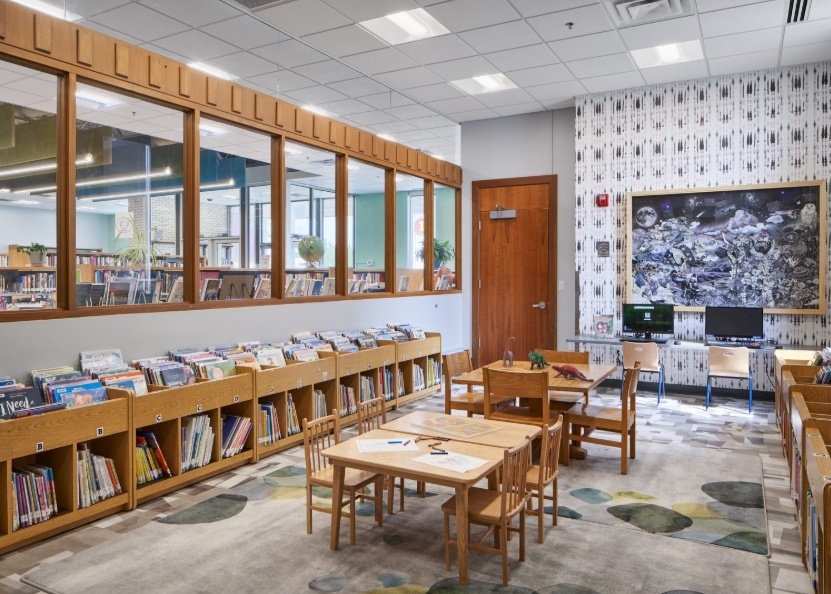
Public libraries have long served as places for reading, discovery, and connection. As the needs of their communities evolve, so does the way families experience the library.
For families with young children, books and storytimes remain essential parts of that experience, but hands-on and interactive learning opportunities can provide another reason to walk through the door. When thoughtfully integrated into a children’s space, educational technology can complement traditional library resources while encouraging exploration, independent learning, and continued engagement with the library.
Wadena City Library in Wadena, Minnesota offers a compelling example.
As the library adapted its spaces and services around the needs of a changing community, interactive early learning became an important part of its approach. Today, two AWE Learning stations have become some of the most heavily used resources in the building, and their impact extends beyond the children using them.
The experience raises a larger question for public libraries:
Can interactive learning technology do more than provide an educational activity for children? Can it strengthen a family’s relationship with the library itself?
Wadena’s experience suggests that it can.
Interactive Learning Can Become a Draw for Families
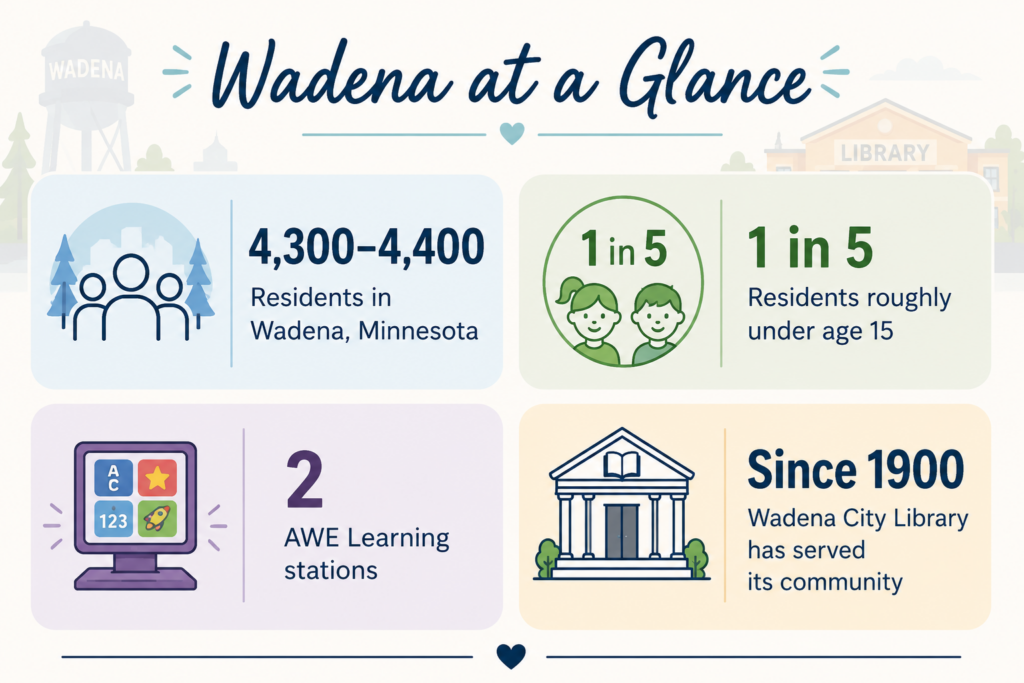
Wadena City Library has grown alongside the community it serves.
A 2017 space needs assessment found that the library’s former building, largely unchanged for 32 years, had reached capacity. As more young families used the library and demand grew for programming beyond traditional collections, staff and city leadership began reconsidering what their library needed to provide.
Among the priorities were dedicated spaces for children, teens, and adults; greater flexibility for community programming; accessibility; and more hands-on learning opportunities for children.
The library moved into its current home in 2023, creating a space designed around those changing needs.
Within its children’s area, interactive learning quickly became an important part of the experience.
Wadena initially purchased one AWE Learning station. According to Branch Manager Renee Frethem, its popularity with children quickly demonstrated the need for another.
“Wadena City Library has two AWE learning stations. We started with one station and quickly realized we needed at least one more due to the popularity with the children.”
— Renee Frethem, Branch Manager, Wadena City Library
Today, usage of the stations matches or exceeds the library’s traditional patron computers. Some families specifically visit the library so their children can use them.
That makes the technology more than another resource within the building.
It becomes a reason to visit.
The Screen Can Be the Beginning — Not the End — of the Library Experience
Educational technology and traditional library resources are sometimes treated as competing experiences.
Wadena’s experience suggests a different relationship.
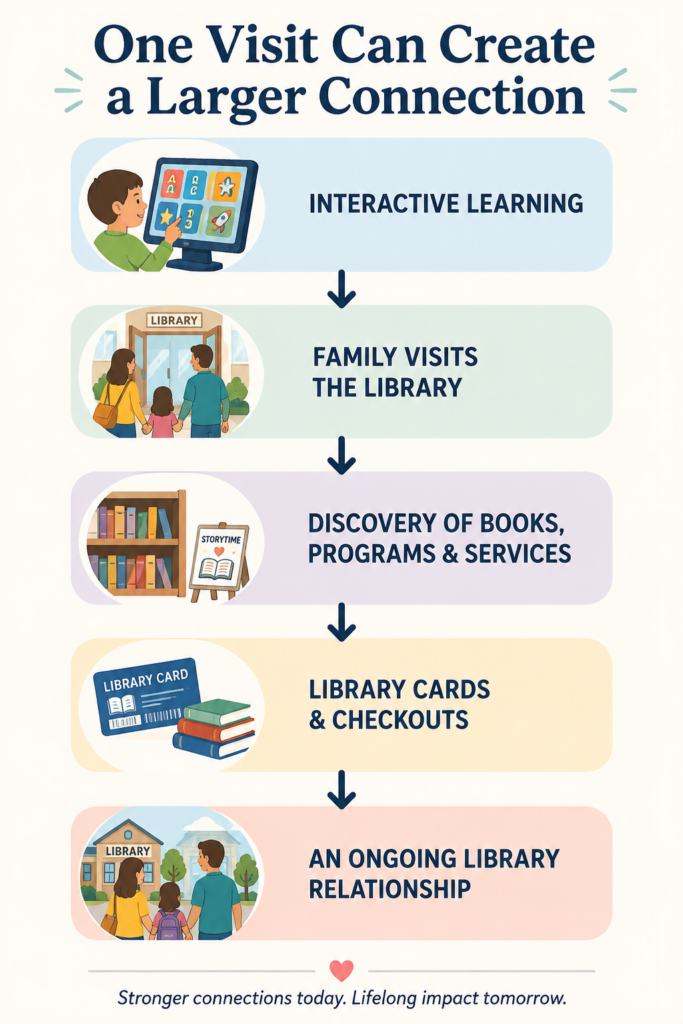
Because the AWE Learning stations are located within the children’s area, a visit that begins with interactive learning naturally places families alongside books, collections, programming, and other library services.
And Wadena has seen that proximity translate into broader engagement.
“Families come in just to use the AWE’s and end up applying for library cards and checking out materials — it’s become a real beacon for bringing new families into the library.”
— Renee Frethem, Branch Manager, Wadena City Library
That ripple effect is significant.
A child may initially be interested in an educational game or activity. That interest brings the family into the library. Once there, the family encounters everything else the library has to offer.
Wadena’s broader family-centered environment supports that connection. The library offers weekly children’s storytimes, summer and winter reading programs, author events, community meetups, and dedicated spaces for different generations.
Interactive learning therefore does not have to replace books or traditional literacy experiences.
It can become another pathway toward them.
Small Libraries Need High-Impact Resources Without High Staff Burden
For small and rural libraries, introducing a new resource involves more than considering whether patrons will use it.
Staff must also consider what it will require to maintain.
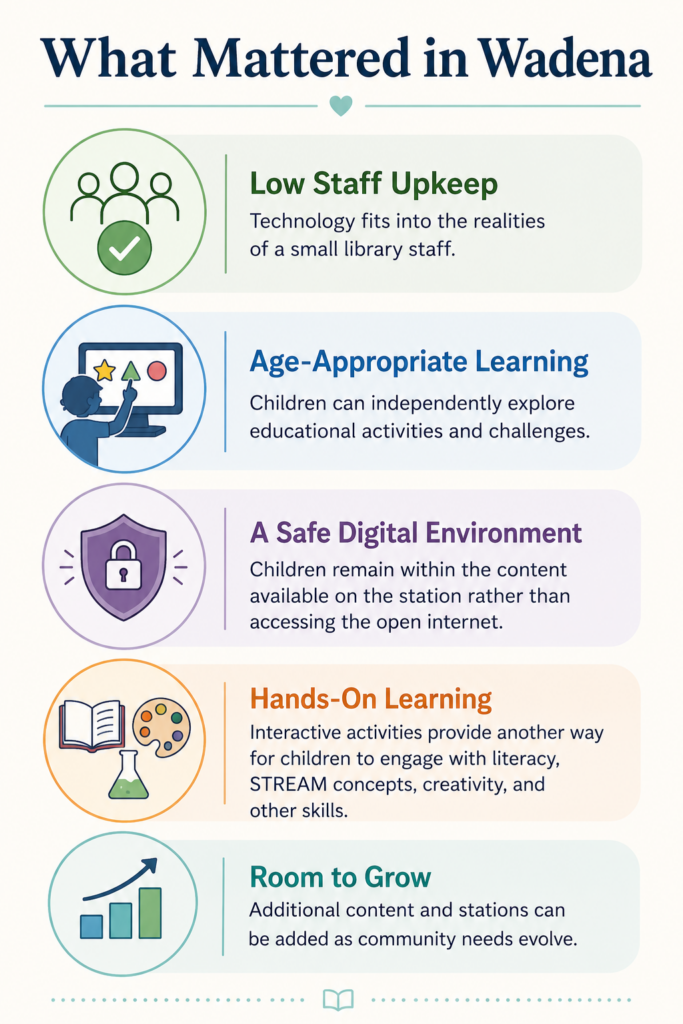
Wadena City Library reports that its AWE Learning stations require very little day-to-day staff upkeep. Routine updates can be handled through a straightforward administrative process, allowing the technology to remain available without creating a significant additional responsibility for staff.
“There is very little staff upkeep on the machines — for a small branch like ours, that matters.”
— Renee Frethem, Branch Manager, Wadena City Library
At the same time, children have access to a range of age-appropriate, STREAM-focused programs and activities through responsive touchscreens, color-coded keyboards, and mice designed to support young learners.
The stations connect to Wi-Fi when updates are needed, but children cannot access the internet, they can only use the educational content installed on the machine.
For Wadena, sustainability also extends to how the stations were funded.
Both were purchased through community donations and grants rather than the city budget, demonstrating how outside funding can help libraries introduce new learning resources while protecting limited operating dollars.
Family-Centered Technology Works Best as Part of a Larger Ecosystem
One of the most important lessons from Wadena is that no single resource transformed the library on its own.
The AWE Learning stations are part of a broader effort to create a library around the families who use it.
Wadena’s current building includes dedicated children’s, teen, and adult spaces. Its children’s area was designed with room to grow as the town’s youngest population grows. A flexible community room accommodates events and gatherings, while drive-through pickup, 24/7 drop-off, and after-hours rentable space make the library more accessible within residents’ everyday lives.
Interactive learning exists within that larger ecosystem.
The result is a children’s space where young patrons can move between different types of learning and discovery, from educational technology to books, storytime, programs, and shared experiences with their families.
This is an important distinction for libraries evaluating technology for young patrons.
The goal is screen time with a purpose, using the right technology to increase engagement with learning and with the library.
What Wadena’s Experience Suggests for Public Libraries
Wadena City Library represents one community, and its experience should not be treated as a universal outcome for every library. However, its experience highlights several considerations for libraries evaluating how interactive learning fits into their children’s services.
1. Children’s Technology Can Become a Family Acquisition Tool
A resource designed for young learners can provide a reason for an entire family to enter the library. At Wadena, some families specifically visit for the AWE Learning stations and subsequently engage with additional library services.
2. Digital and Traditional Literacy Can Complement One Another
Interactive educational technology does not have to compete with books. Wadena has seen visits centered around its learning stations lead to library card applications and material checkouts.
3. Family Engagement Starts With Reasons to Visit
Storytimes, collections, community events, reading programs, and interactive learning can all serve as entry points. Offering multiple ways to engage allows families to build a library experience around their own interests and needs.
4. Staff Capacity Matters
For smaller libraries in particular, the value of a resource must be weighed against the time required to manage it. Wadena identifies minimal staff upkeep as an important benefit of its stations.
5. Community Funding Can Expand What Is Possible
Wadena funded its two stations through grants and community donations rather than its city budget, providing an example of how libraries can look beyond operating funds when introducing new educational resources.
6. Successful Resources Create Demand for Growth
Wadena began with one station, added a second in response to popularity, and hopes to add additional stations as space allows.
“We see these stations as a foundation to build on, not a finished project — as our space allows, we’d love to add more.”
— Renee Frethem, Branch Manager, Wadena City Library
Beyond the Screen
Wadena City Library’s experience demonstrates that the value of interactive early learning can extend beyond the time a child spends at a screen.
For Wadena, the AWE Learning stations have become heavily used resources, but their broader impact may be even more meaningful. They give children another way to learn and explore. They give families another reason to visit. And once those families arrive, they encounter books, programming, library cards, community connections, and the many other resources waiting for them.
That is where interactive learning can have its greatest impact.
The screen is not the destination. It is another doorway into everything the library has to offer.
Enjoy our blog? Subscribe here to receive our quarterly newsletter featuring a new blog directly in your inbox!
Learn more about AWE Learning with your local representative to explore your options.
info@awelearning.com (610) 833-6400
Sources
Wadena City Library / Kitchigami Regional Library System; U.S. Census Bureau, American Community Survey 5-Year Estimates for Wadena, Minnesota; Wadena Area Chamber of Commerce; BKV Group, Wadena City Library project; AWE Learning Company endorsement letter from Wadena City Library, August 2026.
